
“Facts are the enemies of the TRUTH.”
Miguel de Cervantes
On the journey toward becoming a true HUMAN being, we construct multiple realities out of the facts we understand and accept, the meanings we assign, and the perceptions and experiences we accumulate. These realities—created by us and eventually inhabited unconsciously—are often mistaken for the Truth itself.
Do we look at life, events, and one another through the realities built from our facts, or do we see them from the Truth?
Reality is shaped by individual, collective, or societal perceptions and beliefs. Over time, it becomes our reality. We both create it and live within it. The facts that sustain this reality are not false; they are valid within that specific reality. Yet validity does not make them Truth.
At times, we may glimpse the Truth—perhaps through an experience, an insight, or a moment of deep awareness. However, unless this encounter is sustained through continuous inner clarity, we tend to translate the Truth into facts, absorb it into our existing framework, and turn it into our truth. Once this happens, the Truth ceases to be Truth and becomes part of a reality—a constructed version of what was once directly known.

This process should not be judged in terms of good or bad. It is a natural consequence of existence unfolding through differentiation and multiplicity. If the Truth were likened to pure white or pure black, then colors would be our realities.
In this sense, realities are the contextual, time-bound, and condition-dependent confirmations of the Truth. These confirmations solidify as facts, and facts inevitably give rise to their opposites—counterfacts. That is why they are many, and that is why they conflict.
Realities are layered. Each reality contains its own lower and higher levels and operates as if it were a living organism—self-preserving and self-defending. A reality is sustained by the level of consciousness that produces it. Without noticing, we often become advocates of a particular reality, emotionally and intellectually invested in its facts. In doing so, we unintentionally serve the continuation and expansion of that reality, acting as its representatives.
What clash with one another are not Truths, but realities—each supported by its own facts, rights, and wrongs.
This leads to the essential question: Can facts, and the realities they uphold, lead us to the Truth?
They can—only when they are permeated by love, respect, compassion, and patience. Otherwise, facts merely reinforce repetition, trapping us in a closed reality that endlessly reproduces itself. Therefore, while inhabiting any given reality, the minimum ethical responsibility is to work toward coherence and harmony within that reality, rather than absolutizing it.
Consciousnesses that have awakened the Truth within do not negate realities. They respect them. Yet they are not bound by them. Such consciousness works toward unity and wholeness across realities, not dominance of one over another.
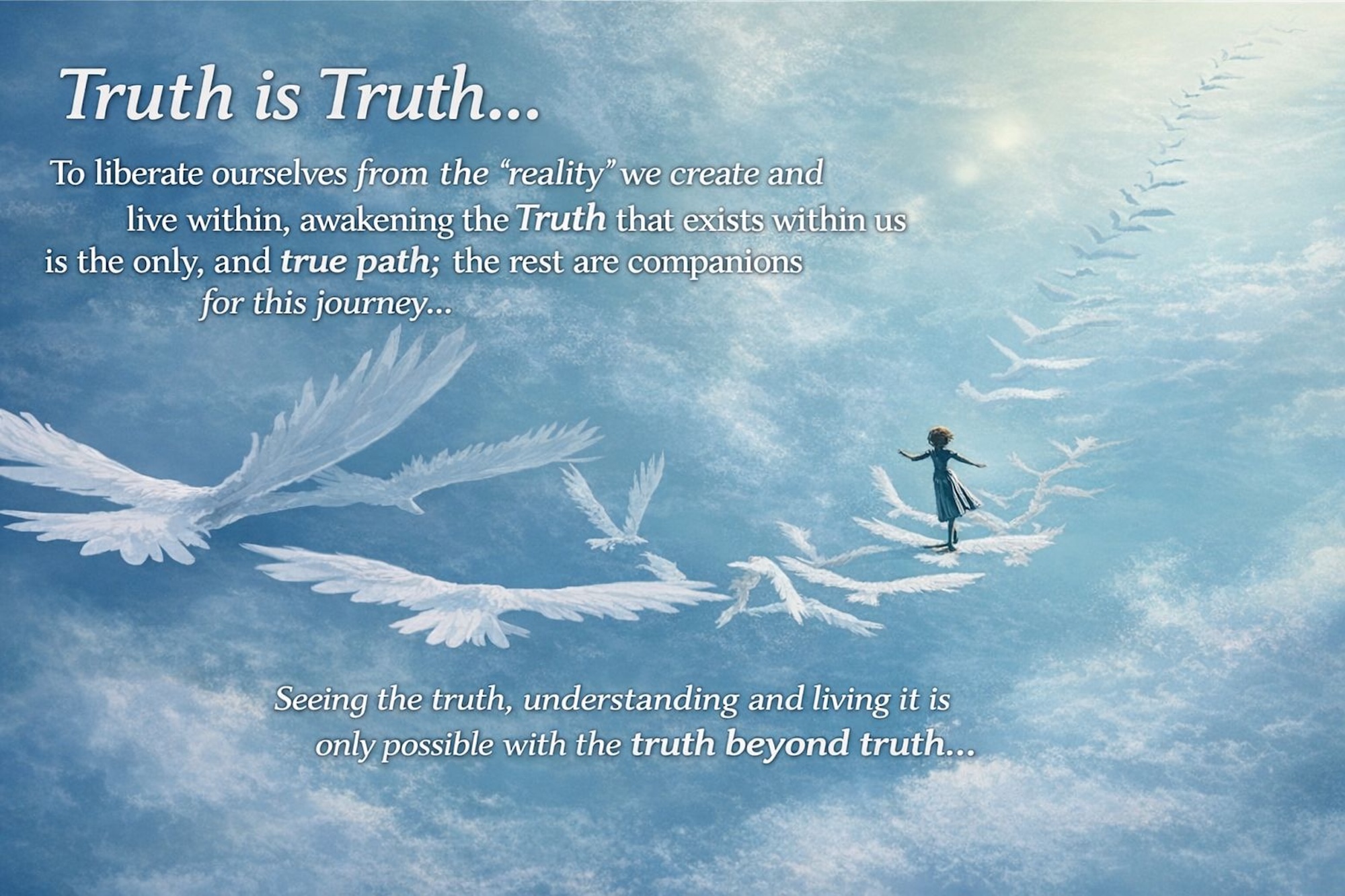
The Truth is the truth, unique, whole, and indivisible.
It exists within us, independent of time, place, conditions, facts, or consensus. It belongs to itself. It unfolds through the intelligence of the Essence and is. The Truth is not constructed; it is recognized. It arises from within and is lived from within.
The Truth has no upper or lower boundary. It is not hierarchical. It is the connective force that holds all realities together. If our realities were likened to the beads of a rosary, the Truth would be the thread that unites them.
When life and events are perceived from the Truth rather than from facts alone, relationships emerge that allow deep mutual understanding. Dialogue becomes reconciling rather than polarizing. Harmony replaces opposition.
The Truth is within us. Yet unless it is born into awareness, we remain confined to a reality. A whole lifetime may pass without ever touching the Truth—only navigating between realities and facts.
To remain awake, we must question our certainties, soften our “impossibles,” examine the reality we inhabit, accept the possibility of more inclusive realities, and turn inward toward the Source of Truth that exists in each of us.
Through this orientation, a genuinely free and independent will emerges, and the unity of mind and heart becomes possible.
Journeying toward the Truth and journeying with the Truth are not the same.
Ultimately, in the process of becoming a True Human being, what must be realized again and again is liberation from the self we have constructed. Only through this liberation can contact with the inner Truth begin.
And then, we touch the Truth of the Whole and start to see—and live—from the Truth.
This process appears simple, yet it is profoundly demanding.
Because only the Truth can touch the Truth.
Memet Ali Kaya, Mart 2017