

MANKIND and THE WORLD
In the journey of self-understanding and self-discovery, perhaps the most challenging and incomprehensible dimension is CONSCIOUSNESS.
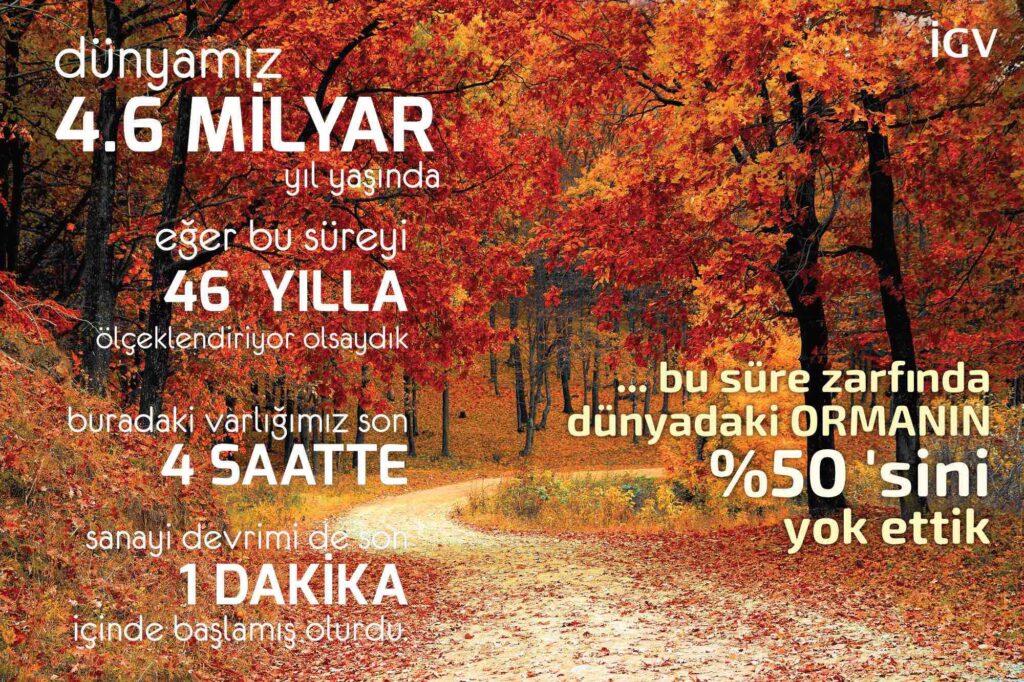
Let’s try to summarize how our world looks like from a general perspective; when we look at the relationship we establish with the nature and environment we live in, the sensitivity or insensitivity we show.
Our Earth is 4.6 billion years old. If we were to scale this period to 46 years, the existence of human beings in the world would correspond to the last 4 hours. In these last 4 hours, we have destroyed 50% of the world’s forests. The industrial revolution, which caused the consumption and pollution of natural resources to a large extent, would have been experienced only in the last 1 minute.
From a general perspective, despite all our intellectual accumulations, we have created an unsustainable population growth, environmental problems, insatiable and endless power struggles, ambitions and injustice. On one hand, rapidly developing technologies, on the other hand, a form of understanding that has become isolated on its own and insensitive to nature and the environment in which it lives has dominated societies.
Technology, of course, will develop and turn into an indispensable element of our lives day by day. So where is the problem?
- Is it in the technology we produce or in the meaning we attribute to it?
- Is it in the disharmony that arises as a result of the isolation and depersonalization that human beings experience first with themselves and then with their environment?
- Is it that we are trapped in our comfort zones and do not choose a conscious awareness without questioning their root causes?
All of them are possible, or there may be other reasons besides those.
Are these ways or approaches directly related to each other? So can one be the cause or effect of the other?
For hundreds of years, human beings have lived in an understanding of life dominated by the patriarchal (masculine) approach. This approach, as a natural consequence of competition and industrial conditions, also led to the fact that one assumed the right to dominate over others. Humanity has experienced this result for long periods and is still experiencing it. Advocating the patriarchal approach as if it were the only reality actually causes the need for social superiority to repeat itself without realizing it.
What is the main reason for our urge and thought to control nature and almost everything that prevents us from living in harmony with nature?
When human beings ended the hunting period and moved to a more sedentary agricultural society, they grew plants and managed to domesticate animals. During this time, duties and genders were equalized. However, over time, the demand for property increased, and after a while, the strong began to exercise power over the weak. This power exercised over nature, animals, enslaved people, especially women and children, turned into a cultural system that could be used by individuals and groups who tended to own and control everything. This patriarchal system, whether we like it or not, has certainly served humanity in some aspects. Today, the fact that this approach and the systems it has created can no longer bring benefits to humanity alone has become visible.
Are we really questioning this deeply enough?
Throughout human history, humanity’s need for cooperation, understanding and compassion has never been stronger than it is today in order to create sustainable and dynamic solutions, conserve resources and maintain a certain level of harmony among the world’s 7.5 billion inhabitants. We need a new understanding of life and production, and the sensitivity necessary for this, more than ever.
Our patriarchal (masculine) approach can no longer produce permanent and sustainable solutions on its own. Instead, it is not enough to put forward the matriarchal (feminine) approach, which “seems to be the opposite”, as a solution. The best thing we can do as humanity; to learn lessons from this process, to honor differences and respect all kinds of thoughts and lifestyles, to serve the existence and flourishing of a holistic approach in which existence is valued and equal at all times and everywhere.
Is this possible? Human history is full of many seemingly impossible success stories. Let’s look back at the courage of the PEOPLE who can say why not, and the hopes and existential dignity of those PEOPLE that are unextinguished despite all kinds of difficulties. In those PEOPLE, we will see an inner compass that is independent of gender and nationality, time and place, and all kinds of circumstances. This compass is a resource that exists within every human being. As long as we want to wake this up and strive on this path.
We tried to deal with the issue from a broad framework. Because the solution to events or problems that “seem to be very big” is hidden in the awakening and discovery of the inner understanding that the human being, who is lost in this greatness (!), “sees as very small” in oneself. It is possible to bring a NEWperspective to perspectives by seeing human beings as the real architects of the solution, not as part of the problem.
Throughout history, there have been countless people who consider themselves to be the true architects and designers of the solution. Today, there are and will always be people who have reached a certain level of consciousness, who add value to the society and humanity they live in, and who feel responsible for this. As a matter of fact, in recent years, it is possible to encounter many reminders that we need to be more questioning, more conscious and aware in relationship and communication, in the understanding of production and consumption, in politics, in belief, and even in our daily habits in general.
The main purpose of this article is not to create a societal answer to these questions or to find solutions to the problems. However, in a way that serves this, it is to be able to look at the question “What would I prioritize if I were starting change and development from myself?” from a certain perspective and to share this perspective with you as much as I can understand.
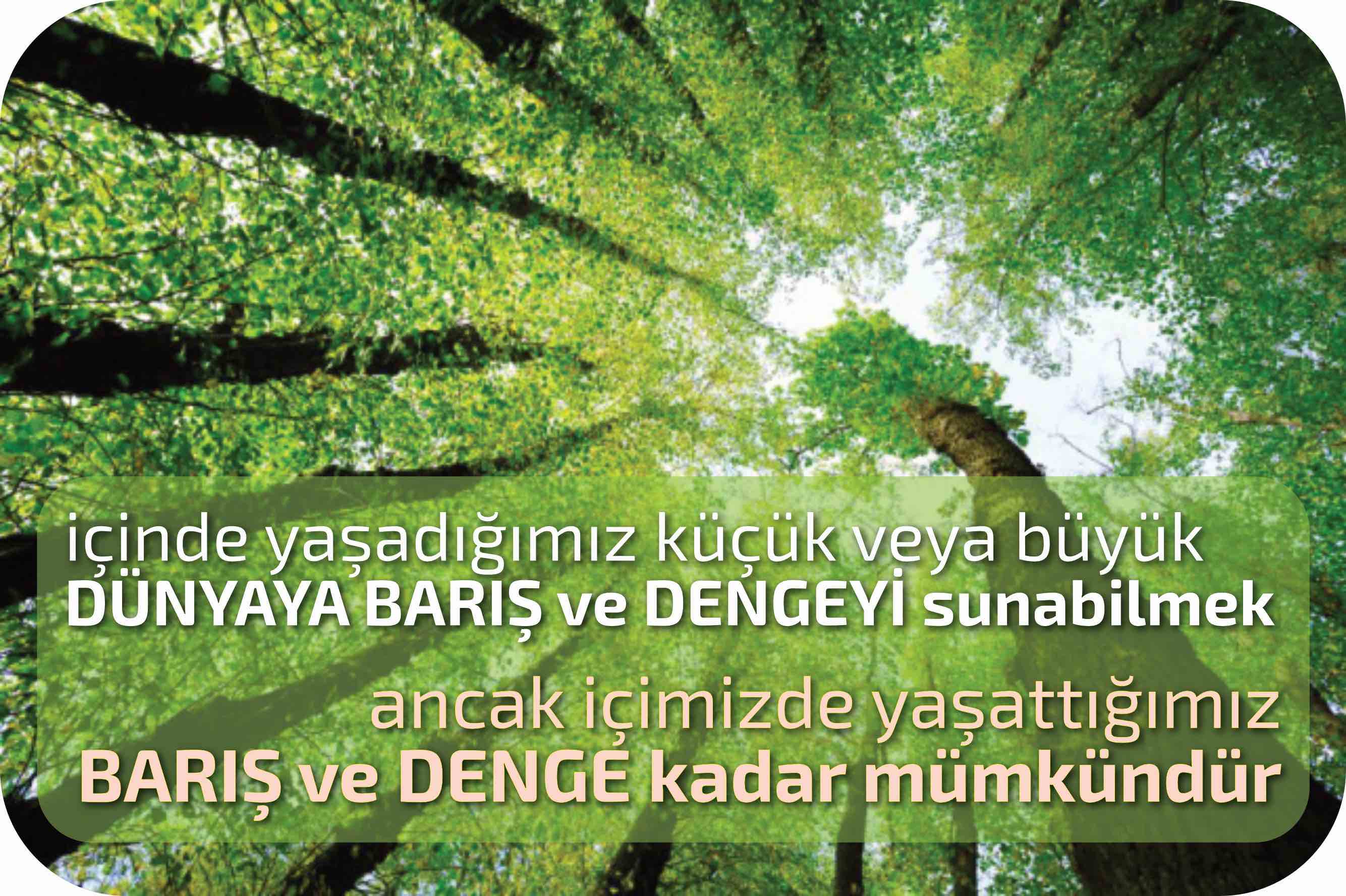
No matter where we are or what task we are in, there is a TRUTH that is independent of circumstances, people, and even time, and that constantly reminds us of itself;
To be able to offer PEACE and BALANCE to the small or big world we live in is only possible as much as the peace and balance we KEEP LIVING WITHIN.
We must have the courage to question deeply in order to develop all our thoughts and actions in harmony with the whole of life. That courage requires to be free from blaming others for it. In such a case, what we produce or consume, even our new discoveries, will serve to rebuild and shape the future instead of enslaving us to itself.

So what can “I” do?
It is possible to start with the famous quote of Socrates: “The secret of change is to focus all your energy on building the new, not fighting with the old.”
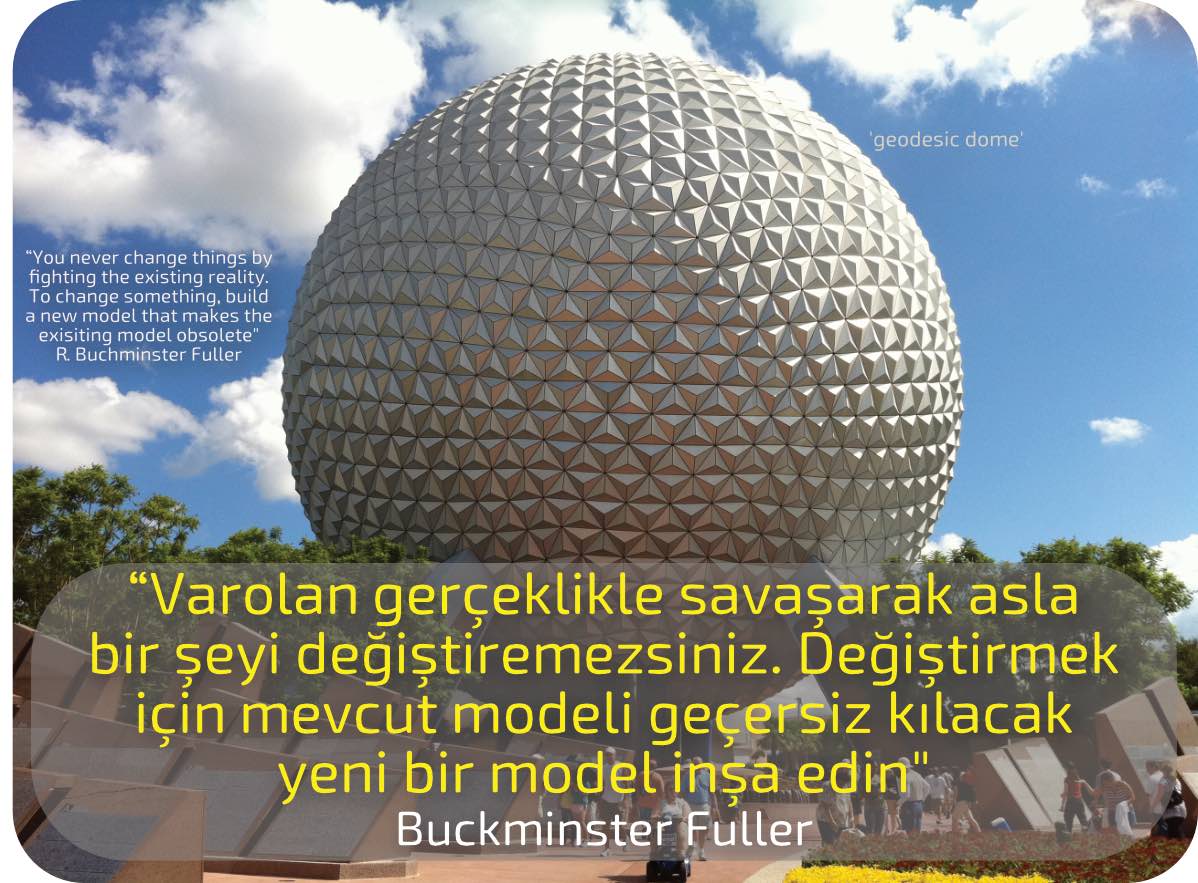
We can also refer to the words of Buckminster Fuller, a designer, thinker and explorer.
“You can never change anything by fighting the existing reality. To replace it, build a new model that will override the existing model.”
First of all, we should start by questioning our own thoughts and actions, no matter how big or small!
- What do I add to the “atmosphere” we live in? What is the amount of intellectual, emotional and physical “carbon dioxide” I produce in daily life?
- After all, how much damage am I doing to our intellectual “ozone layer” as an individual?
- So, am I aware of this effect per square meter on earth?
- Can I do my part of the cleaning?
- Or do I, like many people, consider myself worthless and insignificant, and therefore choose recklessness or insensitivity?
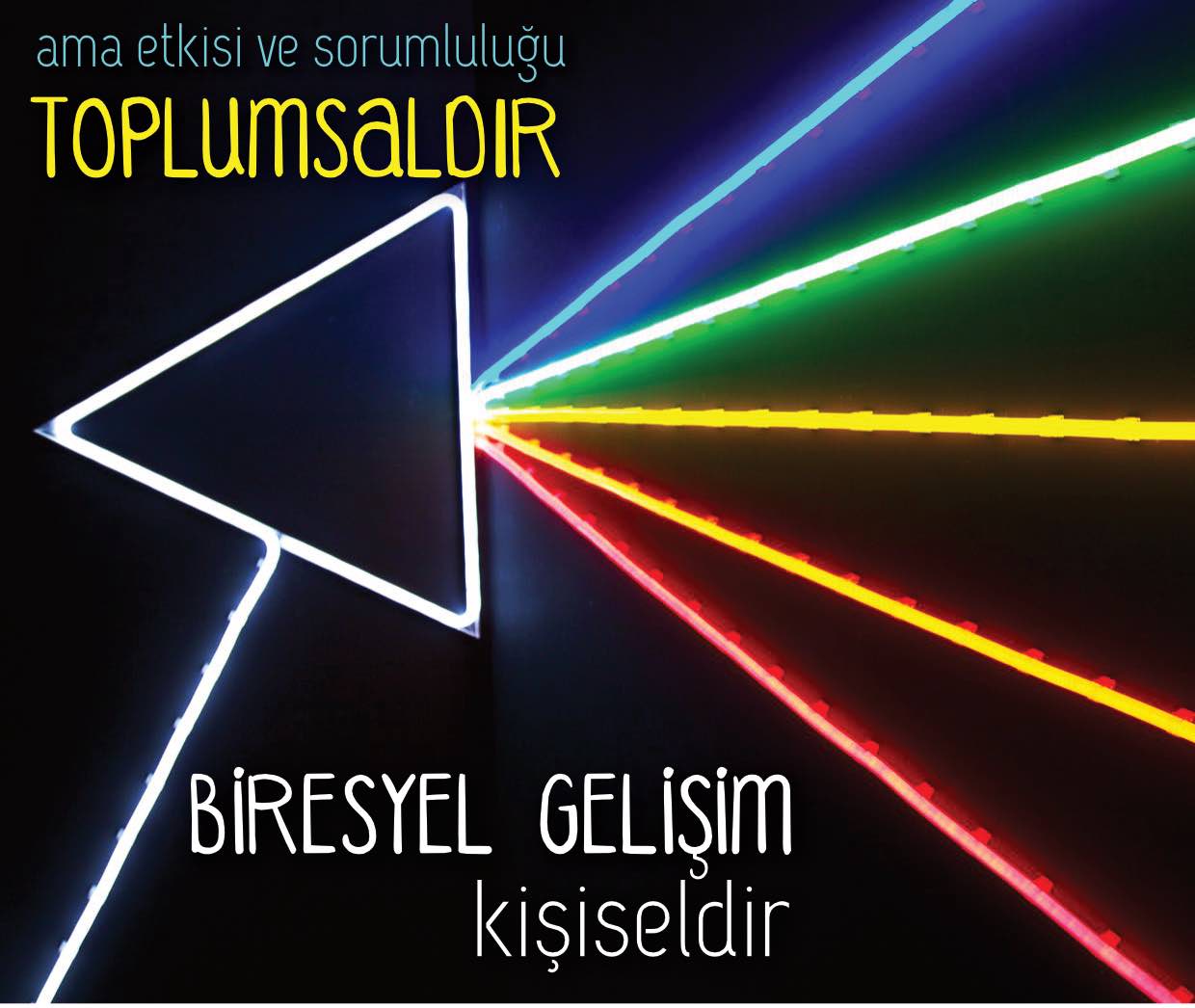
That’s where we have to start. If nothing in the universe is superfluous and insignificant, then I exist as a “potential value“. Everything to one side, when we change our perception of ourselves with a deep-rooted and deep awareness and start living, new perspectives and analyses about the individual and society that we have never thought of until today will be visible to us. In fact, it is none other than “myself” who does not allow this.
I wonder how much I can achieve the “CONSCIOUS AWARENESS FOOTPRINT” as far as I can, like the “carbon footprint”?
Making our choices in our daily lives, even the most ordinary ones, with conscious awareness will add value to ourselves, our environment and ultimately to the present and future development of the society we live in. Because individual development seems personal, but its impact and responsibility are social.
DEVELOPMENTAL STAGES:
Before we examine our masculine and feminine aspects, let’s take a brief look at the history of moral development theory.
Lawrence Kohlberg (1927 – 1987), one of the two teaching professors at Harvard University, and Carol Gilligan (1936 – ), who was his research assistant for a while, worked on the stage of moral development for many years. However, after a while, it turns out that Lawrence Kohlberg and Carol Gilligan have different, even seemingly contradictory, views on this theory of development, which will become an important reference point in educational theory and practice. While Dr. Kohlberg argues that the theory he is working on covers the moral stages of all human beings, Dr. Gilligan emphasizes that the theory is incomplete and does not include the whole of the human being, and that the evaluation of women in particular is incomplete (Kohlberg, 1).
Dr. Gilligan makes this claim strongly in his book “In a Different Voice: Psychological Theory and Women’s Development.” As a matter of fact, after a while, Harvard University Press described this book as ‘a small but revolutionary work‘ (Gilligan, 2) (Slide-1).
Indeed, this is the case. Because Kohlberg states that since all of the subjects in his study are men, the basic values of the moral development steps are based on RATIONALITY and JUSTICE. However, Dr. Gilligan insists that this approach has a shortcoming and cannot be attributed to the whole of HUMAN. So he decides to do his own work, especially with women. As a result of this study, the basic values on which the moral development steps are based; it defines them as RELATIONSHIP and CARE. As can be expected, this approach is considered as a feminine approach and as a matter of fact, it causes a serious debate among some psychological theorists. Later, Dr. Kohlberg concluded that Dr. Gilligan’s work was a kind of complement to his own work, putting an end to a serious debate among psychological theorists that had been going on for a long time.
Even the “development dynamic” of this story in the past can be considered as a good example that summarizes the “dominance and struggle of our masculine and feminine aspects” in the process of perceiving and accepting the moral development steps of human beings. While sharing the example of this struggle or development in psychology, due to this ongoing conflict process, it should not be difficult to guess how challenging and compelling the examples in politics and social life are.
Both scientists mention four stages of development (Gilligan, 2- Wilber, 3) (Slide-2):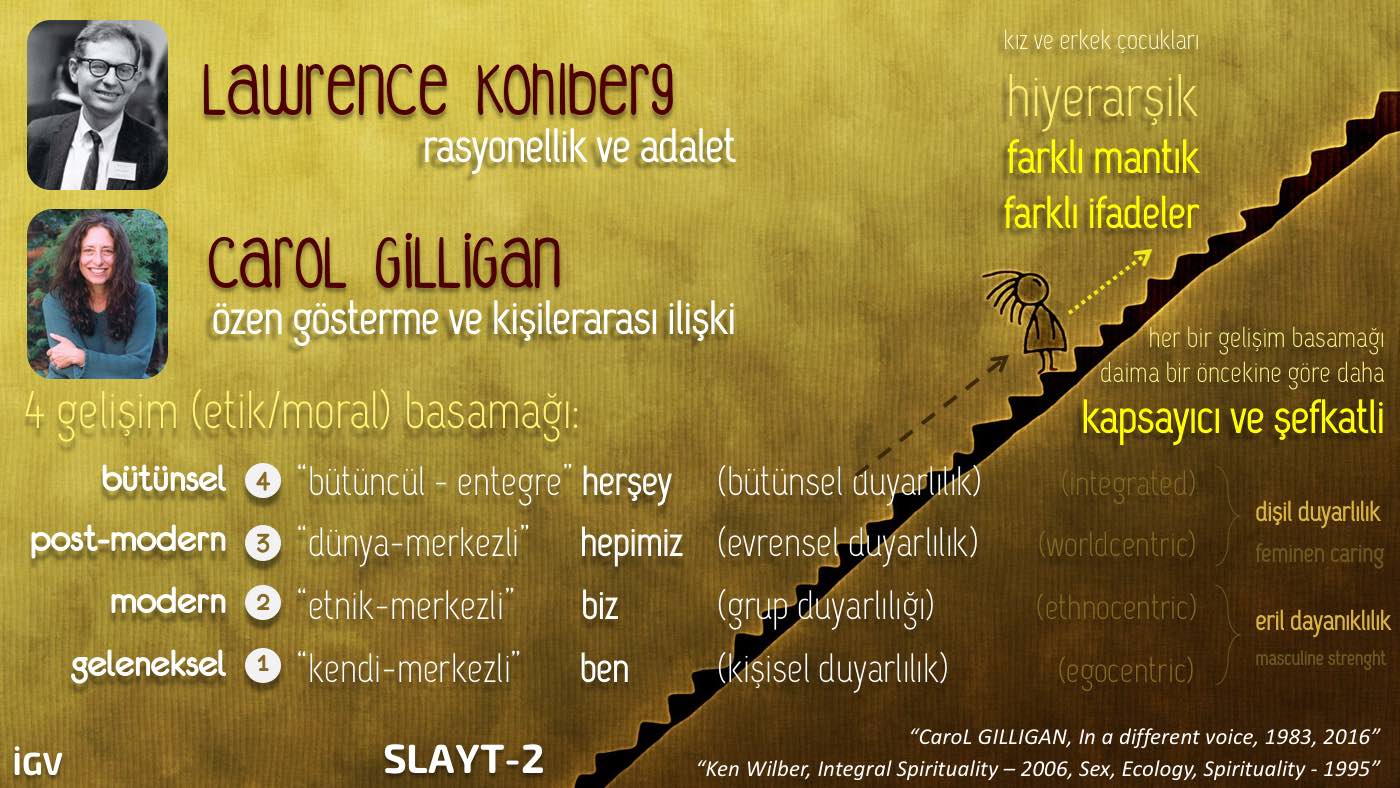
- TRADITIONAL: A phase that is “self-centered” and emphasizes the I. Naturally, it is a period when we prioritize and focus on “Personal Sensitivity“.
- MODERN: An “ethnic-centric” phase that emphasizes WE (our group, race, gender, team, etc.). It is a period in which we prioritize and focus on “Group Sensitivity” rather than oneself.
- POST-MODERN: A phase that is “Earth-centered” and emphasizes ALL of US. It is a period in which we prioritize and focus on “Universal Sensitivity“, including me and us.
- INTEGRITY: A phase that includes EVERYTHING, including all states of being, small and large, abstract and concrete, living and inanimate, which is a “Holistic/Integrated” approach, including realities that we do not yet know or understand. This phase is a developmental period in which we focus on “Holistic Sensitivity” in a way that encompasses all previous phases.
According to scientists, there are two very important basic principles that should not be forgotten in these developmental stages:
- Each stage of development is always MORE INCLUSIVE and COMPASSIONATE than the previous one. This is the basic quality of individual and social development. When we lose this quality, we see ourselves individually or socially as either above or below someone.
- In the same way, girls and boys develop at each stage of this hierarchical moral development, using DIFFERENT LOGIC with DIFFERENT EXPRESSIONS. This principle is accepted as the basic quality of social development as well as individual development. Because societies have masculine and/or feminine tendencies as well as individuals. When we lose this basic quality, we experience deep communication (individual or social/diplomatic) accidents.
Therefore, it is very important to remember these two basic principles in both individual and social development processes.
ENERGY CENTERS and STAGES OF DEVELOPMENT:
Just as in the developmental stages of psychology, it is possible to observe the same developmental stages and dynamics in Eastern philosophy.
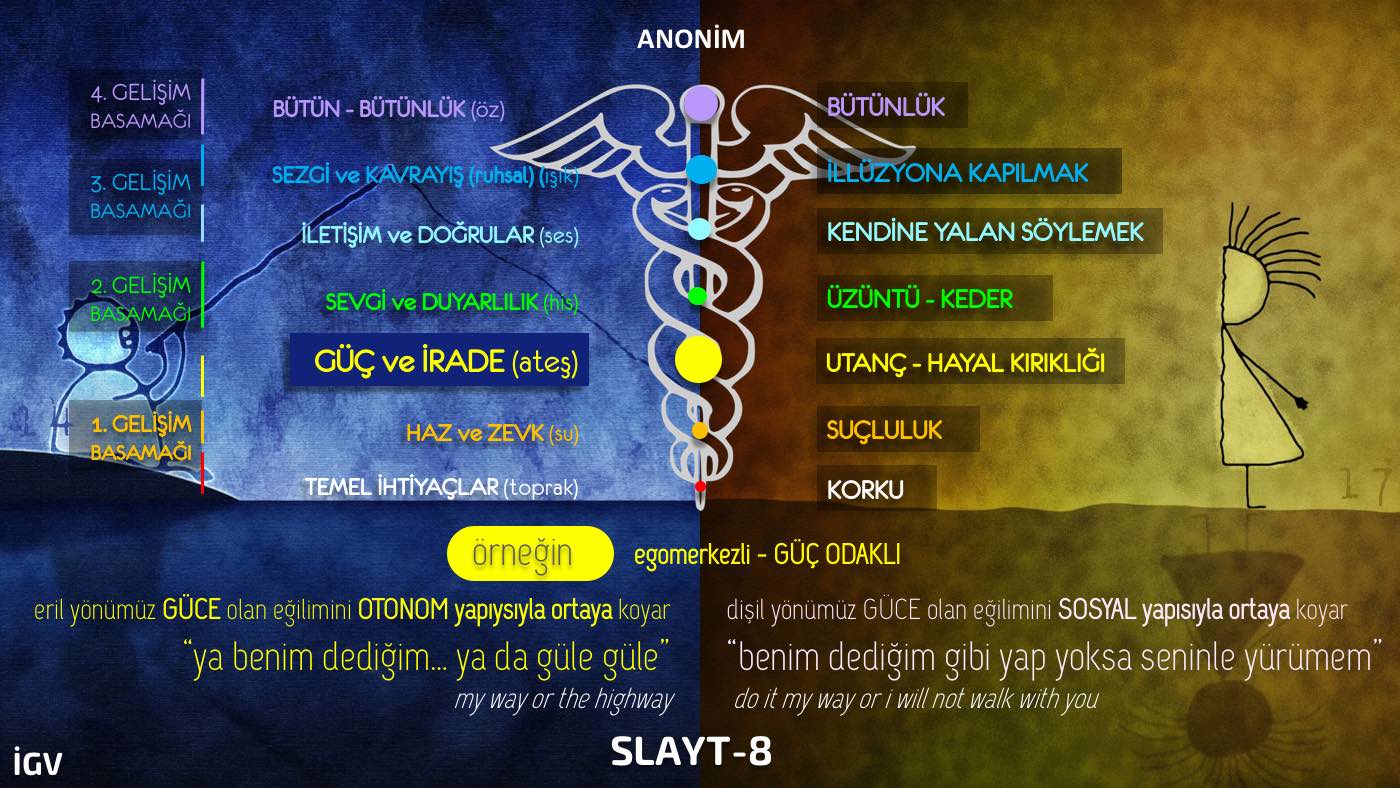
When we evaluate this based on the ancient knowledge of yin-yang and the energy centers (chakras) in humans, our masculine or feminine side will again show different tendencies depending on our current state of consciousness or stage of development. Recalling the basic information about energy centers (Slide 8):
1st STAGE OF DEVELOPMENT:
- 1st CHAKRA: Related to BASIC NEEDS and represented by “EARTH”. This energy center has a sensitivity related to “FEAR”, and in order to achieve a balanced flow, we need to allow our fears to flow and release them.
- 2nd CHAKRA: Related to PLEASURE and ENJOYMENT. Represented by “WATER”. This energy center has a sensitivity related to “GUILT”. To establish balance in this center, we must accept and forgive ourselves in all our states.
- 3rd CHAKRA: Related to POWER and WILL. Represented by “FIRE”. This energy center has a sensitivity related to “SHAME or DISAPPOINTMENT,” and to maintain balance, we must accept and love ourselves with our mistakes.
2nd STAGE OF DEVELOPMENT:
- 4th CHAKRA: Related to LOVE and SENSITIVITY. Represented by “FEELING.” This energy center has a sensitivity related to “SADNESS / SORROW / LOSS” and to feel balance, we must release all sadness because love is actually everywhere.
3rd STAGE OF DEVELOPMENT:
- 5th CHAKRA: Related to TRUTHS. Represented by “VOICE” for communication and expressing truths. This energy center has a special sensitivity related to “LYING TO ONESELF.” To achieve balance at this level, we must ACCEPT our unique nature and purpose as they are, without denying them, and release the things we have denied and the lies we have told up to now.
- 6th CHAKRA: It relates to our ABSTRACT POTENTIAL. It is represented by “LIGHT – SPIRITUALITY” for intuition and understanding. To balance this energy center, we must “NOT FALL FOR ILLUSIONS.” To experience balance at this level, we must release all the illusions within us. The greatest illusion is actually the illusion of separation. Whatever we think is separate and different is actually connected, one and whole in its deep structure, like islands visible on the surface of the water.
4th STAGE OF DEVELOPMENT:
- 7th CHAKRA: Related to TRUTH and WHOLENESS. It is represented by the “TRUE-SELF” in order to experience and reflect wholeness. Experiencing and reflecting WHOLENESS requires that all our thoughts and behaviors be fully within our awareness and control. Maintaining this balance in life is possible by “FREEING” ourselves from all our material and spiritual “DEPENDENCIES.”
As we mentioned above, everyone has masculine and feminine qualities, aspects or tendencies, regardless of gender (physical, biological).
The aspect that adds value by prioritizing ourselves, our spouse or our family (me and mine) is defined as “Masculine Endurance/Strength“. On the other hand, the aspect that adds value to others, communities, the environment or humanity in general is defined as “Feminine Sensitivity“.
If our focus is only on others, we may have a “sensitive but weak” tendency. If the opposite is the case, that is, if our attention and effort are directed only to ourselves and/or our family, then we may have a “durable/strong but insensitive” tendency. Although it is not a basic principle, men generally tend to take a “masculine approach” by taking care of their own (and their family’s) rights, while women, on the contrary, tend to a “feminine approach” by prioritizing the rights of others (Stephens, 4).
We may be exhibiting these traits in immature developmental stages. However, both of these situations are not yet BALANCED situations. Over time, with the balance and unity of these two aspects, we can only lead a life that is truly at peace with ourselves and our environment and adds value to the world we live in.
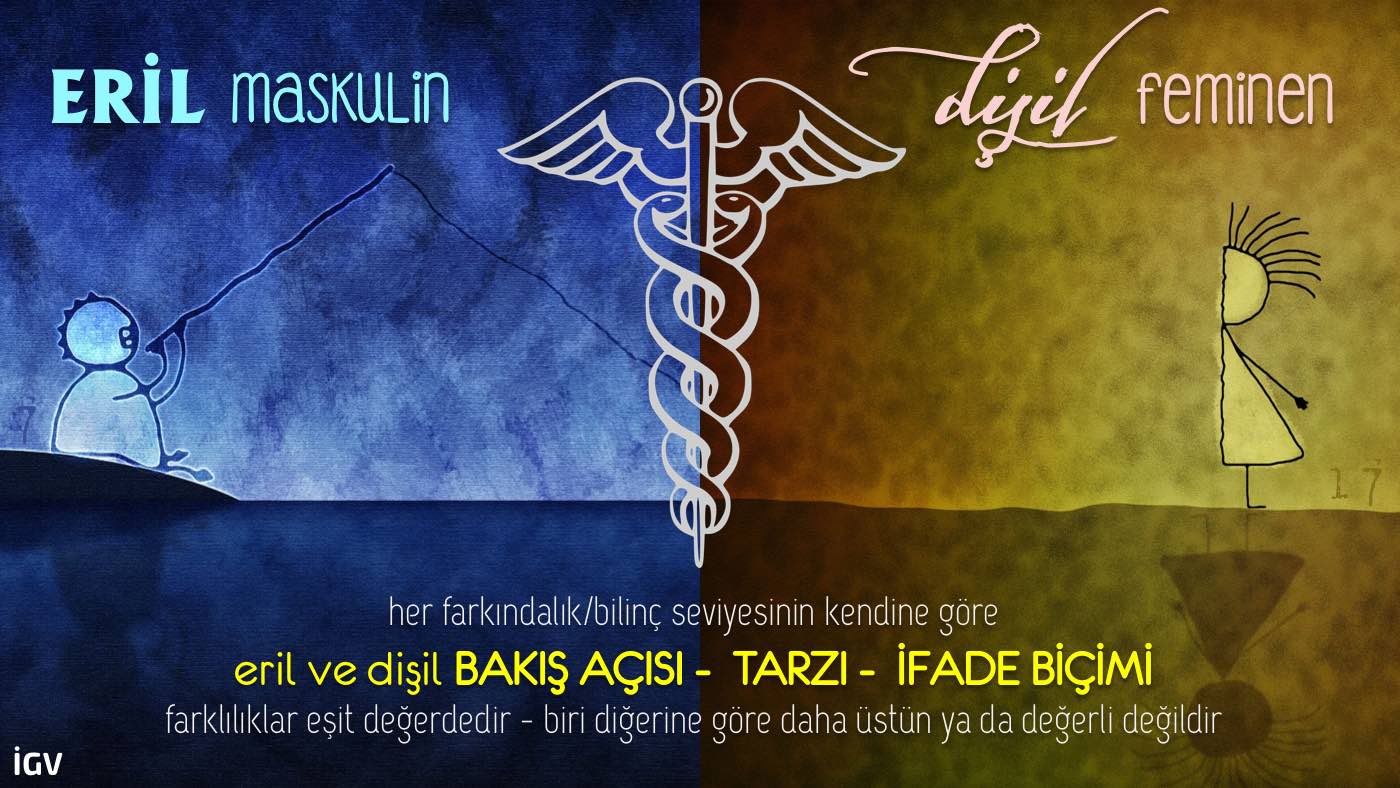
Each stage of development, different level of consciousness or awareness has its own masculine and feminine perspective, a certain style and form of expression. In essence, all of these differences are of equal value, and one is not superior to or more valuable than the other.
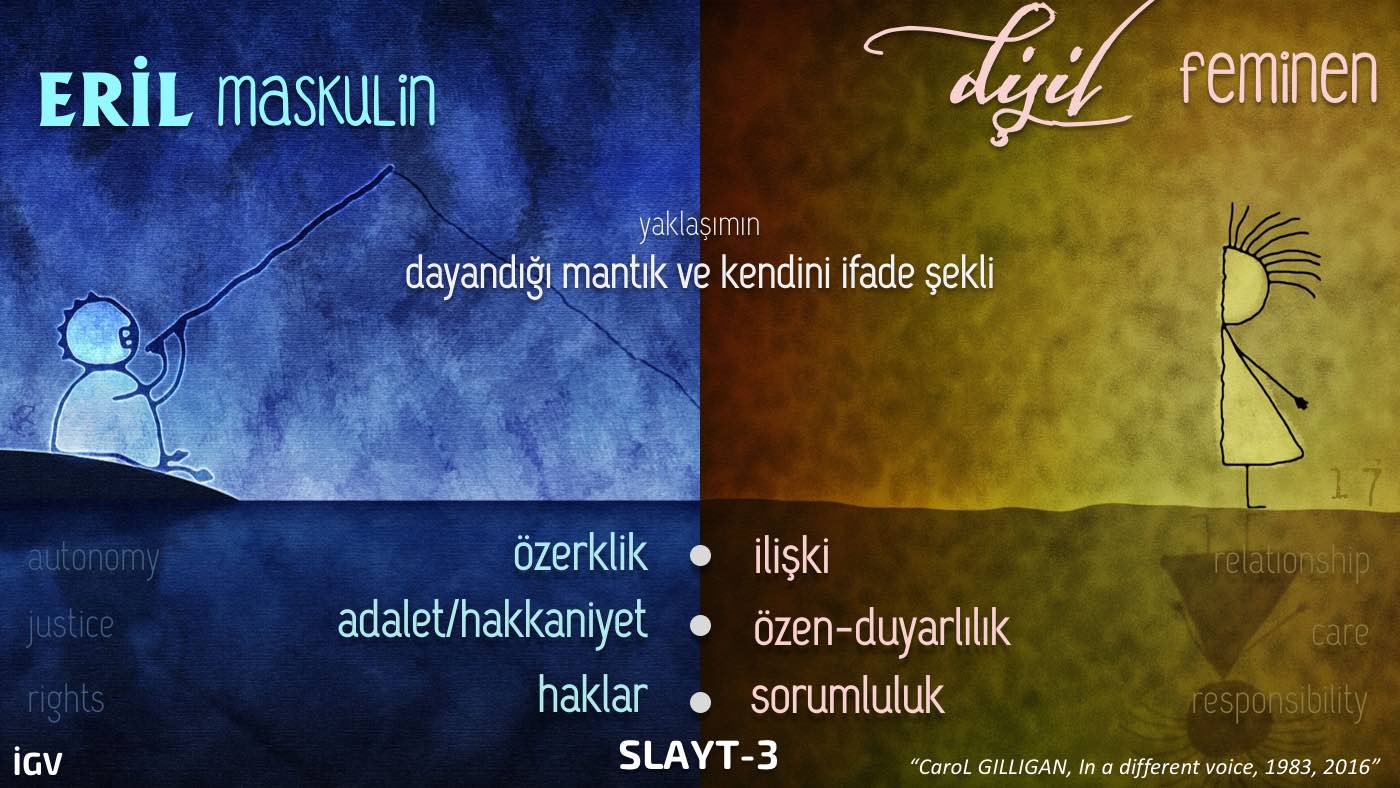
Let’s take a closer look at the fundamental approach and general tendency that “underpins the way we express ourselves and our reasoning” (Gilligan, 2) (Slide-3). In the processes of self-expression, evaluation, or decision-making;
- While our masculine side prioritizes justice, rights and autonomy,
- Our feminine side is more based on relationship, responsibility, sensitivity and care for others.
These aspects of our actions also have their own tendencies (Gilligan, 2) (Slide-4):

If we explain these two different tendencies/approaches with an example (Slide-5);
Boys or men may hurt feelings/bonds to maintain rules, while girls or women may break rules to maintain feelings/bonds.
So, let’s take a look at how the general trend of our HEALTHY (Balanced) and UNHEALTHY (Unbalanced) Masculine or Feminine aspects changes (Gilligan, 2 – Wilber, 3):
Our HEALTHY MASCULINE aspect/tendency (Slide-6); while representing autonomy, power, independence and freedom.
In the case of the UNHEALTHY MASCULINE, in other words, when we lose our balanced state, we either go to extremes in these tendencies or cause the tendency to weaken. That is
- Our tendency towards autonomy turns into “alienation or distancing“,
- Our tendency to power turns into “domination“,
- Our tendency towards independence turns into a “fear of relationships and commitment“,
- Our state of freedom can turn into “fear-based oppression (dominates in fear), sometimes even harm (destroy)“.

Our HEALTHY FEMININE aspect/tendency (Slide-7).; Being in flow represents our relationship-oriented, caring and compassion aspect,
In case of our UNHEALTHY FEMININE tendency, that is, any imbalance in this tendency;
- Instead of being in a natural flow, many things are in a state of FLUTTERING or SINKING (not a connection, but a fusion),
- Instead of existing in the relationship, there is a state of GETTING LOST IN THE RELATIONSHIP (not a flow state, but a panic state),
- Instead of establishing a relationship with a healthy self, there is a state of being guided by the BAG OF RELATIONSHIPS and LOSING ONESELF COMPLETELY (not communion, but a melt-down; not find fullness in connection, but chaos in fusion).

THE BALANCE OF OUR MASCULINE AND FEMININE ASPECTS:
We can summarize the BASIC CHARACTERISTICS that occur when our masculine or feminine tendencyis generally balanced and unbalanced (EXTREME or INSUFFICIENT) in the table below (Slide-9):
THE UNITY OF OUR MASCULINE AND FEMININE ASPECTS
Up to this point, we can evaluate the masculine and feminine characteristics we shared above through two basic dynamics (slide 10a, slide 10b):
- BEING STRONG
- BEING SENSITIVE
As can be seen in the table below (Stephens, 4), these two dynamics may have different weights or gravitational effects according to our preferences or developmental stages. Four approaches emerge that form the basis of our behavior:
- When both our masculine and feminine sides are underdeveloped, we are “insensitive and weak.”
- When our masculine side is dominant, we are “strong but insensitive.”
- When our feminine side is dominant, we are “sensitive but weak.”
- When both our masculine and feminine sides are harmonious and balanced, we are “sensitive and strong.”
This harmony and balance means that the following values/elements exist and thrive in a person’s life:
- Courageous
- Honoring Yourself and Others
- Balanced
- Healthy
- STRONG
- SENSITIVE-CARE (Love)
- WHOLENESS
- WISDOM
The wisdom referred to here is a state of knowing and living that is much deeper than intellectual knowledge. In a sense, it is about opening space for the power and sensitivity within us and the new awareness that arises from their wholeness, and trusting them. The more we allow these new awarenesses to guide our thoughts, words, and actions, the more we help our power and sensitivity become more balanced and whole.


As a result; Regardless of our gender, balancing our masculine and feminine approaches within ourselves and becoming HEALTHY MASCULINE or HEALTHY FEMININE is the first and basic step of development. This first step is the prerequisite for the journey of the human being to become “HUMAN”, that is, to become the “TRUE SELF“. Only when the unification of Healthy Masculine and Healthy Feminine is formed do we become HUMAN.
Through this experience, it becomes possible to discover our SPIRITUAL (individual/internal/abstract) and MATERIAL (social/external/concrete) aspects and the true harmony that exists between them. This harmony is possible with the integration of two seemingly contradictory ORIGINAL voices and approaches and becoming ONE. This ONENESS is described as WISDOM in ancient knowledge (Slide 11).
This state of Oneness and Wholeness can be described as “WISDOM IN ACTION.”
From this perspective, we can observe that wisdom is a process that exists right within life itself. In this sense, wisdom is not an abstract, theoretical understanding beyond behavior, but rather a practical (active) way of life that manifests itself in daily life. It is a constantly growing and evolving journey with the human being awakening from the inside out.
Thus, we become a WHOLE PERSON who adds value to one’s environment and life, is at peace with oneself, tranquil and whole.. By consciously living this harmony, we serve, in proportion to our existence, the emergence of a NEW UNDERSTANDING OF HUMANITY that is sustainable, evolving, collaborative, powerful, and equally sensitive.
It is possible to summarize this long article with a single word;
… Bringing PEACE and BALANCE to the WORLD we live in is only possible to the extent that we maintain PEACE and BALANCE within ourselves …
This essence and understanding has always existed and will always exist. Just as it exists now and within you.

BIBLIOGRAPHY:
The Sun of Humanity Foundation and the Sun of Wisdom Society’s Seminar Programs and internal studies have been generally utilized.
- Lawrence Kohlberg (1927-1987) Wikipedia.
- CaroL GILLIGAN, In a Different Voice – Psychological Theory and Women’s Development, 1983 – 1993 – 2016, Harvard University Press and Wikipedia.
- Jack Stephens, Integrated Masculine and Feminine Balance, 2013.
- Ken Wilber, Sex, Ecology, Spirituality – 1995, Integral Spirituality – 2006.
Synthesis, compilation, and commentary;
Memet Ali Kaya, Ocak 2018
One Comment
Leave A Comment
You must be logged in to post a comment.
About the Author: Memet Ali KAYA




Oldukça kapsamlı bir inceleme/değerlendirme olmuş. TDK “Denge” için farklı açıklamalar vermiş, yazı tümüne dokunmuş;
1. Bir nesnenin veya bir insanın devrilmeden durma hâli
2. Zihinsel ve duygusal uyum
3.Siyasi güçlerin, yetkilerin birbirini sınırlayacak biçimde dağıtılması
4. Ekonomik hayatın uyumlu düzeni
5. Birbirini ortadan kaldıran güçlerin sonucu olan durma hâli