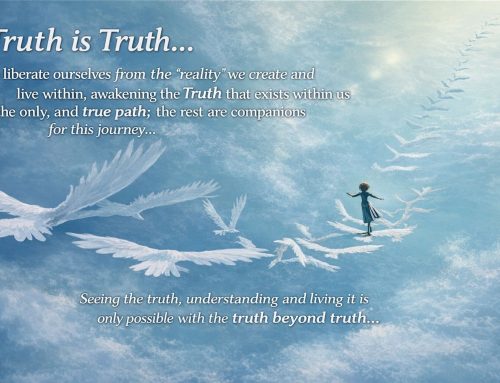

… consciousness is the will that transforms infinite potential into the reality of time and space …
Consciousness is a concept that is difficult to explain and to reach consensus on. Perhaps for this reason, a wide variety of explanations and definitions have been proposed. Moreover, each explanation is deep enough to constitute a separate academic article on its own. If we approach these diverse definitions from a holistic perspective, with the awareness that each reflects a different facet of the whole, we may be able to arrive at a shared understanding.
What is the thing we call “consciousness,” and how should we approach its definition? When one begins to research the topic, dozens of books, hours of video conferences, and pages of academic articles immediately appear. After studying them, one realizes that almost no one agrees on a single definition of consciousness, and that even mutually contradictory definitions exist. Since 1994, an international conference on consciousness has been held every year. Philosophers, scientists, physicians, biologists, theologians, and scholars of religion come together to discuss consciousness. Their aim is not necessarily to find a single definition, but rather to broaden horizons of thought.
 |
Let us approach the subject of consciousness from a more fundamental level. In a sacred hadith, the Creator says: “I was a hidden treasure; I wished to be known.” The notion of the “hidden treasure” is a subject. If we focus on the second part, the expression “I wished to be known” points to the concepts of knowing and being known. But what is knowing? Who knows, and what is known?
According to Aristotle, all human beings desire to know. This is one of the most fundamental human needs arising from existence itself. When Socrates said “Know thyself,” he emphasized the importance of knowledge for human beings and its connection to the effort of self-knowledge. Since the sixth century BCE, when one of the Seven Sages, Chilon of Sparta, inscribed “Know thyself” on the Temple of Apollo at Delphi, countless sages and philosophers—from Socrates to the Buddha, from Lao Tzu to Ali ibn Abi Talib, from Krishnamurti to Seneca—across East and West, North and South, have reflected on life and existence and emphasized the importance of knowing, and especially of knowing oneself.
The human effort to know oneself began in antiquity, has continued uninterruptedly, and still continues today. Mualla Sevim Güven, the founder of our association and foundation, also drew attention to wisdom by stating, “A wise person is one who knows oneself,” defining self-knowledge itself as wisdom.
Hacı Bayram Veli expressed this insight in his verses:
“Bayram knew his essence, He found the Knower in remembrance, The one who finds becomes oneself, Know yourself, know yourself.”
With these lines, he conveys that one can only know oneself upon reaching one’s essence, that with this union one realizes that the true knower is the essence itself, and that the one who finds the essence becomes one with it.
Yunus Emre, the light of Anatolia and a symbol of simplicity and purification, states:
“Knowledge is to know knowledge, knowledge is to know yourself,
What is the use of all your learning If you do not know yourself?
With striking simplicity, he expresses that true knowledge concerns self-knowledge, and that learning which does not bring one closer to oneself has no real benefit.
Rumi also points to the same theme in many of his verses, linking self-knowledge to the awareness of being both host and guest. When you know yourself, who is the guest within this body and this heart? Is it you, or someone else?

If there is an act of knowing, then in the state of cognition there must be both a knower and a known. Could consciousness then be the field that unites the knower and the known, enabling cognition and serving as the space in which knowing takes place?

In definitions of consciousness found in various sources, we see many concepts intertwined, and even presented as synonymous with consciousness. Definitions are highly fluid, and each field defines consciousness from its own disciplinary perspective. Professor Sultan Tarlacı, in his book Consciousness, defines the mind—often confused with consciousness—as “the function of processing and making sense of information coming from our senses and images in our memory.” He defines intellect as the faculty of acquiring knowledge, knowing, recognizing, and judging. In the same book, consciousness is defined as “a state in which a person who is awake and aware perceives internal and external stimuli and responds appropriately to them.” It continues: “Consciousness is the fundamental fact of human existence, because without consciousness, all other human qualities of our existence would be impossible.”
Ibn Arabi, who crowned Sufism with the understanding of wahdat al-wujud (the unity of being), places intelligence at the center in his own distinctive style. According to Mehmet Genç, Ibn Arabi states that human beings can reach “knowledge of truth” by directing intelligence inward—through intuition or unveiling. When intelligence connects to the universal and the absolute truth he calls a‘yan al-thabita, intelligence gives rise to intellect, through which knowing and understanding the truth becomes possible. In other words, truth can be found through inward focus—through the heart and intuition. However, he emphasizes that true knowledge of reality can only be realized through the unity of intellect and intuition, reason and heart. Sultan Tarlacı similarly defines reasoning and intuition as the two poles through which consciousness accesses knowledge.
We are in a domain where fluid definitions and overlapping concepts abound: sense, perception, feeling, thought, intuition, emotion, cognition, comprehension, wakefulness, intellect, understanding, awareness, intelligence, mind… Could consciousness be the field in which all these arise? When we look at a beautiful painting, we are absorbed by the harmony of lines and colors, rarely noticing the canvas behind them. Could consciousness be the canvas of the beautiful painting we call life?
The Turkish Language Association defines consciousness as “the human ability to recognize oneself and one’s environment; awareness… the state of being aware of one’s own existence, senses, thoughts, and surroundings, and knowing that one is aware.”
Etymologically, the Turkish word bilinç derives from the root bil (to know). As in words like sevinç (joy), utanç (shame), the suffix -inç indicates the source of the root; thus, bilinç means “the source of knowing.”
In English, consciousness derives from Latin, from the root scio, meaning “to know.” The prefix con- adds the meaning of “together” or “within.” Thus conscious means “knowing together” or “inner knowing.” The closest Turkish equivalent of conscious is vicdan (conscience). Consciousness thus acquires the meaning of a “state of inner or shared knowing.”
In Arabic, consciousness is expressed as shu‘ur, but further research reveals the concept idrak al-wujud, meaning “awareness of existence” or “the apprehension of being.”
Science and psychology add further depth to the discussion of consciousness. Sir Roger Penrose, who received the Nobel Prize in Physics in 2020 for his work on gravitational waves, frequently addresses consciousness in his writings and lectures, defining it as “the capacity for free will, imagination, thinking, and purposeful action.”
Psychology offers various definitions of consciousness:
- The clear and vivid monitoring of perceptions and information in the mind.
- Awareness of one’s internal and external world, and knowledge of one’s actions and experiences.
- Consciousness is also referred to as “waking consciousness” or “conscious awareness,” which is crucial for the development of the self.
Etyen Mahçupyan, in his book “Understanding the Human”, traces a continuum from brain to mind, from mind to thought and emotion, to imaginal mapping, and finally to consciousness. He argues that subjectivity and the emergence of the self are only possible through conscious awareness. He defines subjectivity as the formation of a perspective in consciousness regarding mental images and identifies judgment as the fundamental function of consciousness.
In psychology, waking consciousness encompasses perceptions, emotions, and thoughts occurring while we are awake. It also includes sensation, perception, decision-making, learning, memory, thinking, creativity, and intelligence. Consciousness itself cannot be directly observed; it is inferred through behavior. From this framework, Freud introduced the concepts of id, ego, and superego. Initially, he examined the mind through the lens of consciousness and the unconscious but later proposed a structural model. Ego, id, and superego are not physical parts of the brain but abstract functional systems with fluid boundaries.
Carl Gustav Jung, building on Freud’s foundations, defined the human psyche as consisting of consciousness, the personal unconscious, and the collective unconscious. Neuroscientist Sinan Canan offers a metaphor: if the unconscious is a dark forest, consciousness is the flashlight illuminating whatever it is directed at. Consciousness may thus be the boundary between the known and the unknown.
Neuroscience suggests that consciousness emerges from the interconnectedness of neurons—not from the physical connections themselves, but from their integrated relational structure. Thus, consciousness can be described as a field of integrated information, knowing, and experience. David Eagleman likens the brain to a radio: the radio does not produce the broadcast; it receives it. Similarly, the brain may be a receiver accessing the “field of consciousness.”
Neurobiology distinguishes science and consciousness through objectivity and subjectivity. Science concerns objective measurement, while consciousness concerns subjective inner experience. Consciousness relates to the subject’s felt awareness of inner experience.
Cybernetics and artificial intelligence further expand our horizons. Machines can process information, make decisions, and even generate creative outputs. However, whether artificial intelligence possesses subjective experience remains unanswered.
Quantum physics, emerging in the early twentieth century, revealed that subatomic particles behave differently when observed. The observer affects the observed. From this perspective, consciousness is seen as a fundamental causal factor. Consciousness asks the question, and reality responds by taking form. In this view, consciousness is neither subject nor object but an active process—the act of manifestation itself.
As Haluk Berkmen states in Quantum Wisdom and Sufism: “Human consciousness determines what reality is. The level of consciousness is shaped by one’s knowledge and wisdom.”
Although reaching a single definitive definition of consciousness is difficult, integrating these perspectives allows us to approach a comprehensive understanding. In humanity’s journey toward truth and the construction of reality, consciousness emerges as the will to seek, find, know, understand, and realize the self. Consciousness is the center that transforms infinite potential into lived reality within time and space.
Murat ULU, 2024
Resources:
- https://en.wikipedia.org/wiki/The_Science_of_Consciousness
- https://consciousness.arizona.edu/about-conference
- Sultan Tarlacı, Prof.Dr., 2019, Bilinç – Beyin, Zihin ve Benliğin Keşfi, Destek Yayınları, 263s.
- https://www.youtube.com/watch?v=JxgtDn185js&t=989s
- https://en.wikipedia.org/wiki/Consciousness#Etymology
- Ahmadi Shahwali, Dr., 1997, “Abraham in Idol-House” – Mapping Identities in the Persian Poetry of Muhammad Iqbal, University of California in Los Angeles, Doktora Tezi, 242s.
- https://ibnarabisociety.org/oneness-of-being-wahdat-al-wujud-aladdin-bakri/
- Roger Penrose, 1997, Shadows of the Mind, Oxford University Press, 457s.
- Nurhan Er, 1998, Bilinç ve Bilinçaltı Kavramlarının Kronolojisi: 17.yy’dan Günümüze Kadar, Türk Psikoloji Yazıları (Turkish Pscyhological Review), Sayı 1(1), s.1-16.
- Etyen Mahçupyan, 2020, İnsanı Anlamak – zihinden zihniyete kendimizi tanımanın bilimsel zemini, Hayykitap, 1.baskı, 390s.
- https://www.psikonet.com/id-ego-superego_nedir-125.html
- Murat Ukray, 2016, Jung Psikolojisi, Yason Yayınları, 268s.
- Stuart Hameroff, https://www.closertotruth.com/series/toward-science-consciousness
- Christof Koch, 2018, What Is Consciousness?, Nature, Vol.557, s.9-12.
- https://www.youtube.com/watch?v=r2dQgdktUJg
- https://www.youtube.com/watch?v=Cq33iTwbkic
- https://www.closertotruth.com/episodes/why-consciousness-so-mysterious
- Haluk Berkmen, Prof.Dr., 2015, Kuantum Bilgeliği ve Tasavvuf, Aura Yayınları, 368s.